Recently, the research team of nano mechanics in the Faculty of Civil Engineering and Mechanics at Jiangsu University, led by Professor Tang Chun and Associate Professor Wang Liya, and in collaboration with Professor Zeng Xiao Cheng’s group from the City University of Hong Kong, discovered a new class of non-van der Waals moiré material: magic-angle twisted bilayer ice (TBI) which is dominated by the hydrogen-bond network. Their research result was published in the prestigious journal Nature Communications, titled "Twisted bilayer ice as a new class of hydrogen-bonding moiré materials." Jiangsu University is the primary completion institution, with Associate Professor Wang Liya as the first author of the paper, Dr. Jiang Jian from the City University of Hong Kong, Professor Tang Chun from Jiangsu University, and Professor Zeng Xiao Cheng from the City University of Hong Kong are co-corresponding authors.
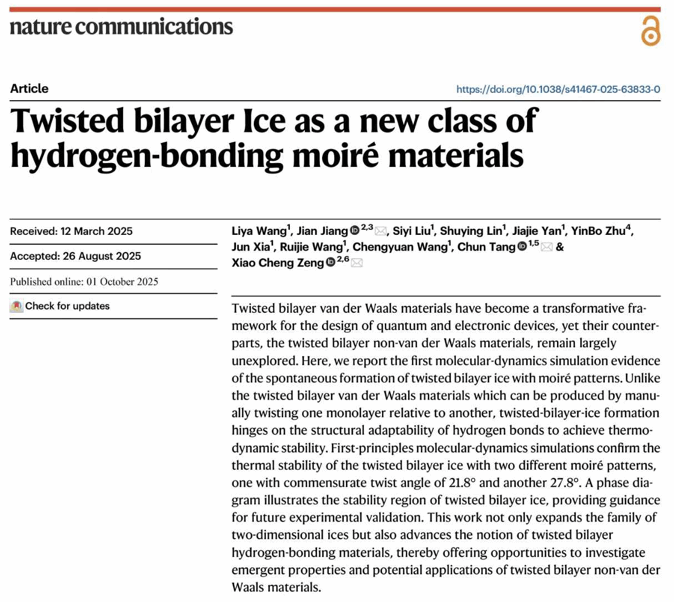
Twisted bilayer van der Waals materials are considered as the central elements in quantum devices due to their unique moiré superlattice effects and extraordinary physical properties. Traditional research has focused on van der Waals material systems, which require artificial stacking of 2D materials at high presicion to achieve desired electronic state modulation, which hinders its applications in the near future. Water, as one of the most abundant substances on Earth, can form rich structural phases and belongs to the non-van der Waals material category. However, understanding of its structure remains limited, it is therefore listed as one of the 125 unanswered scientific questions by Science magazine. Whether stably twisted structures can form in such hydrogen-bond-dominated systems remains mysterious. The research reported in this article show for the first time that TBI with moiré superlattices can spontaneously form in nano-confinements. In contrast to traditional van der Waals moiré materials that require manual twisting, the formation of the two stable twisted configurations of TBI—with twist angles of 21.8° and 27.8°—relies on the structural adaptability of hydrogen-bond networks, opening a new window for the study of hydrogen-bonded moiré materials.
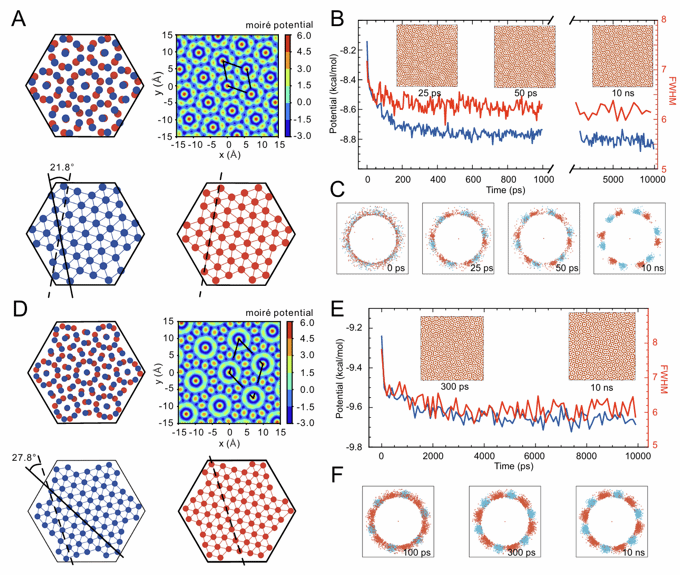
The phase diagram established by the research shows that TBIs are stable within specific pressure ranges and confinement widths. This sensitive environmental dependence suggests its potential as a novel nanofluid-based switching material, while its moiré potential field holds promise for modulating quantum states in low-dimensional electronic systems. The spontaneous formation mechanism proposed by the team provides a general design principle for developing non-van der Waals twisted materials.
This work was supported by the National Natural Science Foundation of China, the Jiangsu Postdoctoral Foundation, the Hong Kong Global STEM Professorship Scheme, and the Hong Kong Research Grants Council.
Link to the article: https://www.nature.com/articles/s41467-025-63833-0


